
Hotel Key Cards
PVC and eco RFID key cards for door locks, printed with room branding and encoded to your PMS.
rfid cards
A card and a key fob are usually the same chip and the same encoding in a different body. What changes is how the holder carries it: in a wallet with a full-colour printed face, or clipped to a keyring where print area gives way to impact resistance.
Selection guide
Cards suit staff badges, hotel keys and membership needing full-colour print on both sides. Key fobs suit doors and vehicles where durability beats print area.
PVC and eco RFID key cards for door locks, printed with room branding and encoded to your PMS.
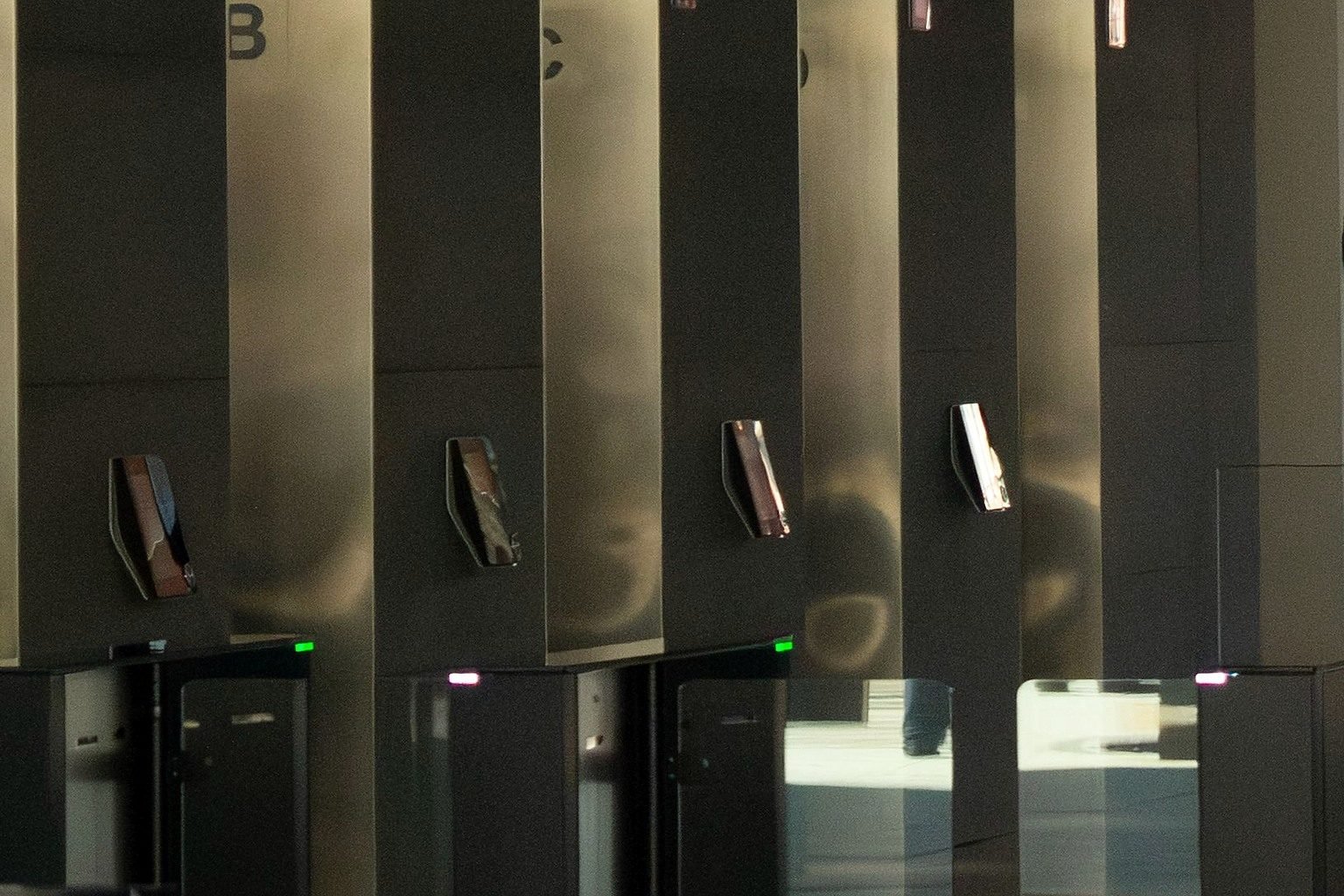
Staff badge cards and key fobs for door controllers, printed with photo ID or plain for pre-printed badge holders.

PVC or metal NFC cards that share a contact, portfolio or payment link with a tap -- no app required on the receiving phone.

Compact ABS or epoxy NFC keyfobs that share a contact, social profile or link with a tap -- the keyring-mounted counterpart to an NFC business card.
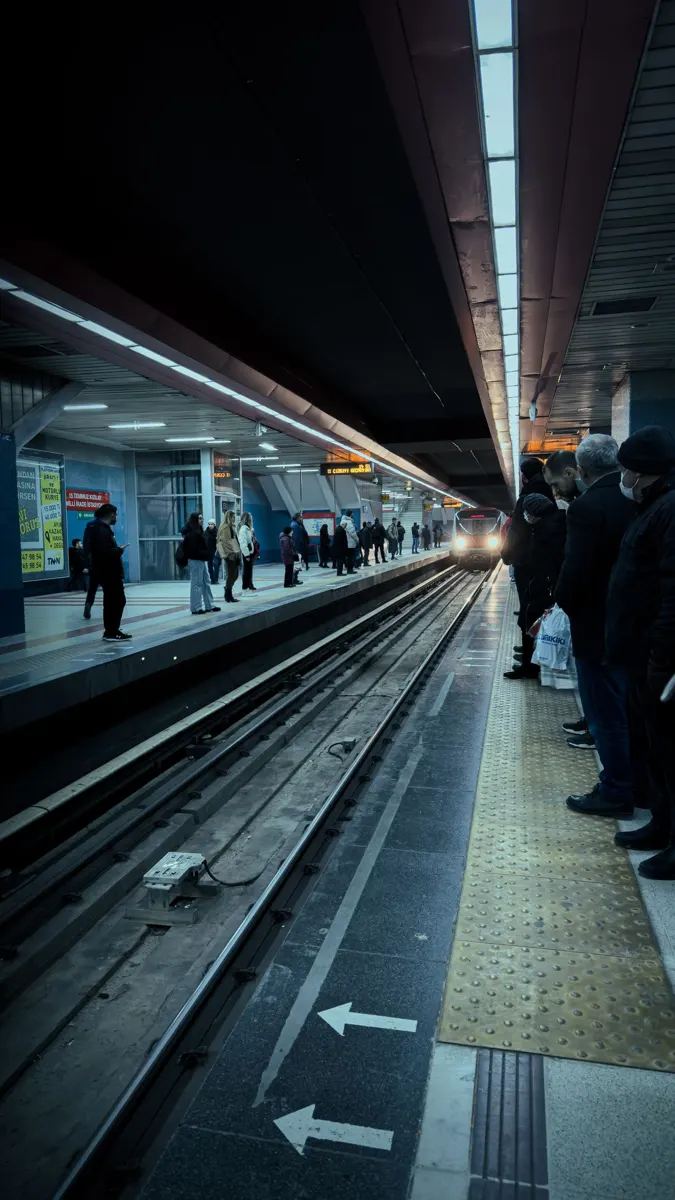
Contactless fare and closed-loop payment cards built around the same MIFARE and DESFire families transit systems already use.

Printed membership and event-access cards with sequential numbering that matches the encoded ID for check-in systems.
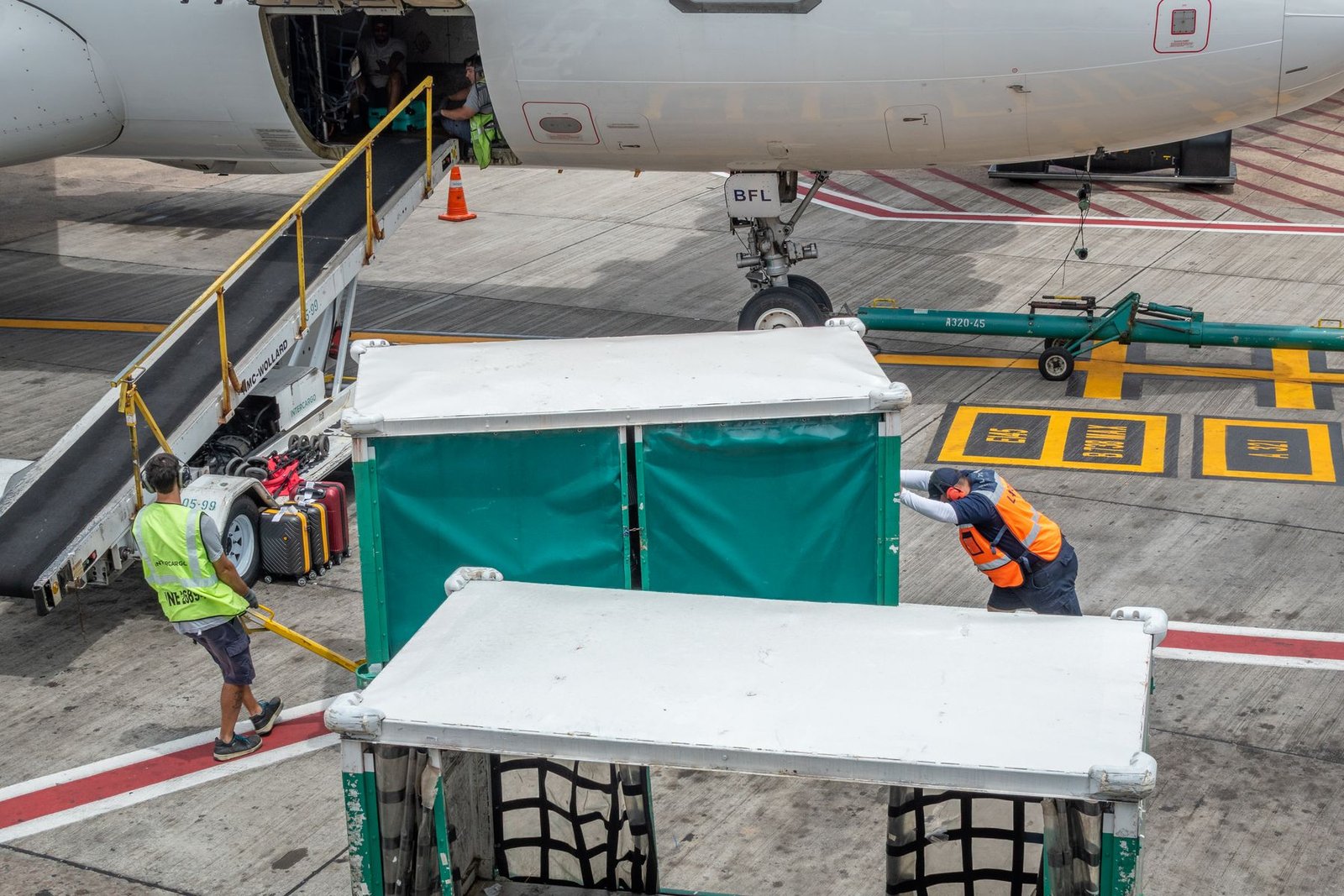
Durable staff and contractor ID cards for airside and transit-facility access control.
Access cards and key fobs for server-room and facility door control, matched to your existing reader family.

Impact-resistant ABS and epoxy key fobs for tool cribs, patrol checkpoints and fleet vehicle access.
Product range
28 real, in-production SKUs in this range. Search by name or SKU, filter by product type or frequency below, or browse the full list and use the page numbers to see the rest.
30-second self-service finder
Pick surface, frequency or range below to see the top 2–3 sample matches and add them directly to your quote list.
Showing top sample picks for this category.
OEM & ODM capability
Material, chip, printing, numbering, encoding and packaging are all built to your order and matched to your reader system. Logo and artwork are part of the standard build, not an add-on.
PVC, PET-G, recycled PVC, natural wood, metal or transparent bodies -- chosen for how the card is used, carried and presented.
MIFARE, NTAG, ICODE, EM, T5577 and contact chips -- matched to your existing reader or lock, not a fixed catalogue.
CMYK offset on both sides with UV, spot white, metallic foil and hologram effects -- plus photo, name and variable data per card.
Printed numbers, UID and chip data follow one scheme -- encoded, verified and delivered with a matching list.
Epoxy-dome, ABS and iButton key fobs in standard or custom shapes -- the same chips and encoding as our cards.
Standard CR80 (85.5 x 54 mm) in 0.76 or 0.84 mm, thin tickets, or custom sizes and die-cut shapes.
125 kHz LF, 13.56 MHz HF / NFC, or both in one card -- UHF cards and windshield tags are a separate range.
Bulk boxes, individual sleeves or gift packaging -- packed in your numbering order with batch records intact.
Production & quality control
From validated sample to finished card -- the real production stages behind every order.
PVC core sheets, inlay materials and chip stock staged and inspected before production begins.
Full-colour CMYK artwork offset-printed onto the PVC face sheets, front and back.
Antenna coil wound and bonded to create the contactless inlay.
The chip module is spot-welded to the wound antenna coil to complete the inlay.
Each inlay is electrically tested for chip bonding, frequency response and read/write function before lamination.
PVC core sheets, inlay and printed face sheets are stacked and hot-laminated under pressure into a solid sheet.
Individual CR80 cards, or a custom shape, are die-cut from the laminated sheet.
Appearance, dimensions, print registration, encoding and read/write performance checked, plus batch sampling.
Cards boxed in the confirmed sequence, with full batch traceability.
Finished cartons palletized and staged for bulk shipment.
How to choose
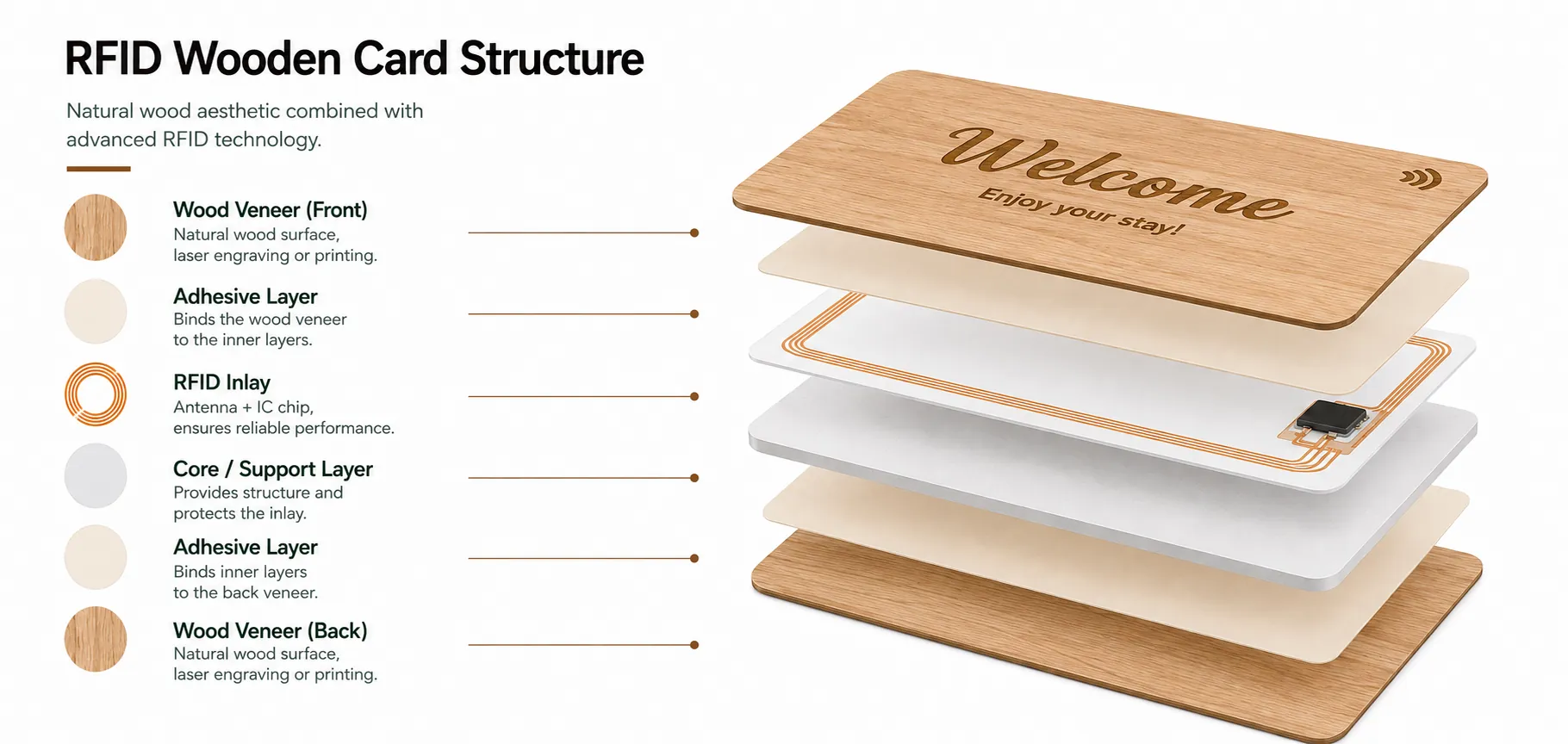
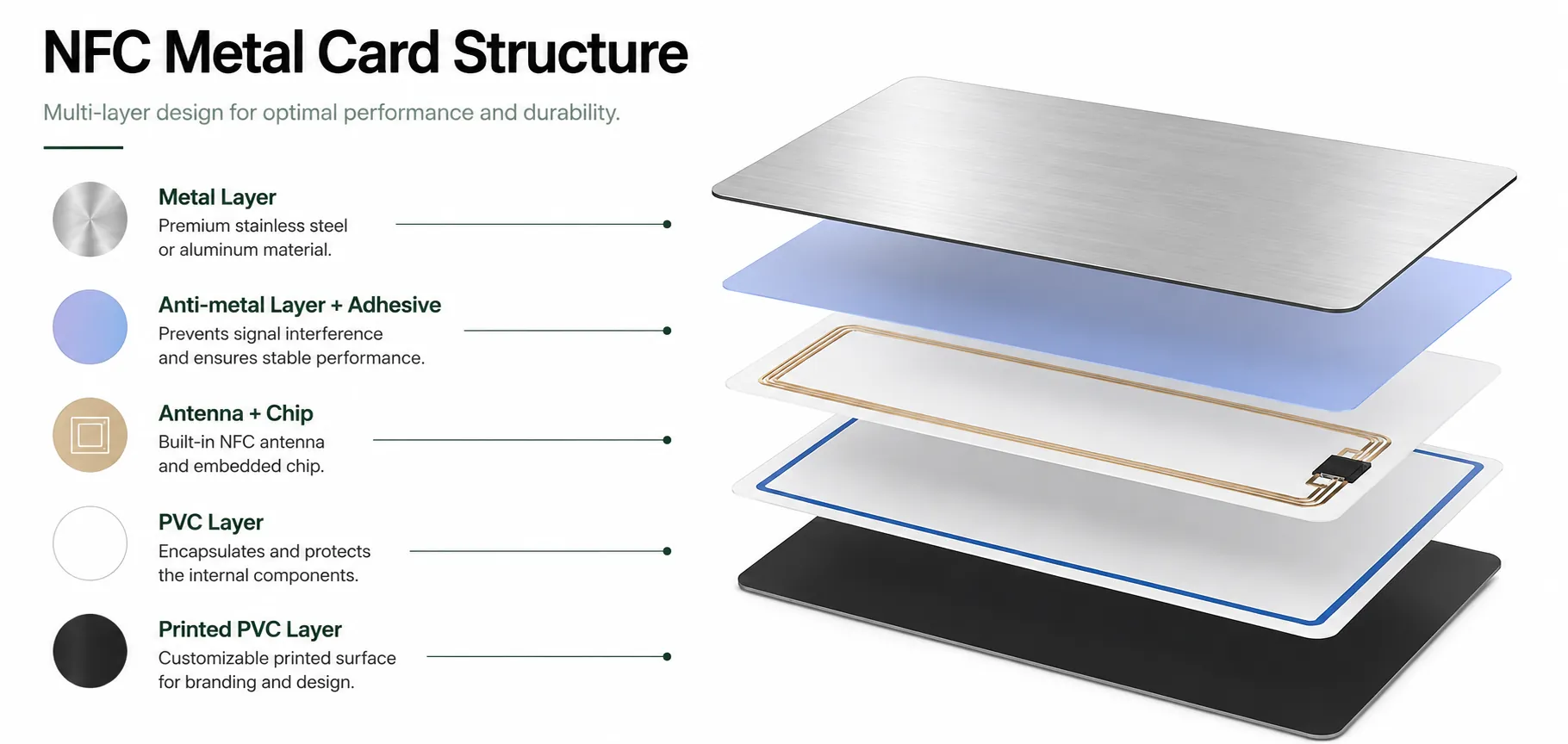
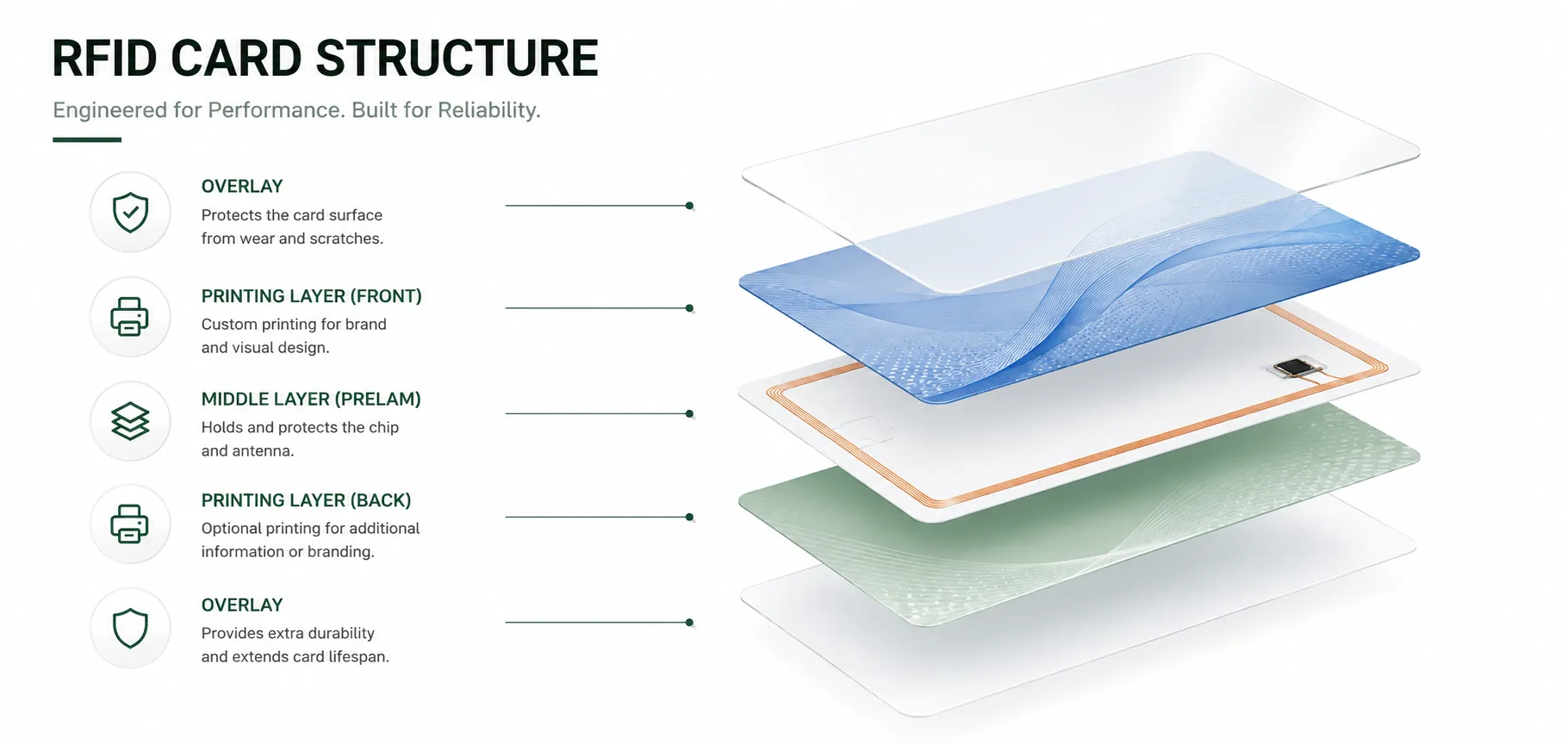
A card is a laminated sandwich, not a single sheet. The inlay sits in the middle, protected by PVC core and face sheets on either side, then sealed under heat and pressure into one solid card.
What chip family your existing controllers or readers already use -- MIFARE, NTAG, 125 kHz or UHF.
Card for wallets and printed ID, key fob for doors and rougher daily handling.
125 kHz for legacy systems, 13.56 MHz for the current standard, or UHF for long range.
Full-colour artwork, photo ID and sequential numbering, front and back.
Printed numbers matched to the encoded UID or block data your system expects.
Test against your real reader or controller before mass production.
Scratch and UV protection over the printed graphics.
Full-colour CMYK artwork, laminated on the top and bottom.
The antenna and chip, centered in the card body.
The structural body of the card, around the inlay.
Heat and pressure bond every layer into one solid card.
Chip options
Chip choice is OEM/ODM too -- we match your existing reader or controller, not a fixed catalogue. Send a photo of a working card or your reader model and we will confirm it.
The default access-control and transit chip family worldwide. Classic covers most legacy door systems; Plus and DESFire add AES encryption for higher-security campuses and payment.
| Model | Memory | Protocol | UID | Read/Write Cycles | Typical Use |
|---|---|---|---|---|---|
| MIFARE Classic 1K (S50) | 1 KB EEPROM | 13.56 MHz, ISO14443A | 4 or 7-byte | 100,000 | Hotel keys, access control |
| MIFARE Classic 4K (S70) | 4 KB EEPROM | 13.56 MHz, ISO14443A | 4 or 7-byte | 100,000 | Higher-capacity access, multi-application |
| MIFARE Ultralight | 512-bit (64 bytes) | 13.56 MHz, ISO14443A | 7-byte | 100,000 | Single-use tickets, low-cost transit |
| MIFARE Ultralight EV1 (48/128 bytes) | 384 / 1024-bit | 13.56 MHz, ISO14443A | 7-byte | 100,000 | Tickets with basic anti-counterfeit |
| MIFARE Ultralight C | 144 bytes | 13.56 MHz, ISO14443A | 7-byte | 100,000 | 3DES-secured single-use tickets |
| MIFARE Plus SE / X / S | 1 / 2 / 4 KB | 13.56 MHz, ISO14443A | 4 or 7-byte | 200,000 | Classic-compatible security upgrade |
| MIFARE DESFire EV1 (2/4/8K) | 2 / 4 / 8 KB | 13.56 MHz, ISO14443A | 7-byte | 500,000 | Campus, transit, closed-loop payment |
| MIFARE DESFire EV2 (2/4/8K) | 2 / 4 / 8 KB | 13.56 MHz, ISO14443A | 7-byte | 500,000 | Discontinued by NXP -- EV3 is the current replacement |
| MIFARE DESFire EV3 (2/4/8K) | 2 / 4 / 8 KB | 13.56 MHz, ISO14443A | 7-byte | 500,000 | Current high-security campus/transit/payment |
The standard NFC Forum Type 2 chip behind phone-based NFC -- business cards, smart posters and loyalty taps. No app required on the receiving phone for a basic tap.
| Model | Memory | Protocol | UID | Read/Write Cycles | Typical Use |
|---|---|---|---|---|---|
| NTAG213 | 144 bytes user memory | 13.56 MHz, ISO14443A, NFC Forum Type 2 | 7-byte | 100,000 | NFC business cards, smart posters |
| NTAG215 | 504 bytes user memory | 13.56 MHz, ISO14443A, NFC Forum Type 2 | 7-byte | 100,000 | Loyalty and app-linked NFC tags |
| NTAG216 | 888 bytes user memory | 13.56 MHz, ISO14443A, NFC Forum Type 2 | 7-byte | 100,000 | Larger payloads -- multi-link or vCard NFC cards |
| NTAG 424 DNA | 416 bytes | 13.56 MHz, ISO14443A, AES | 4-byte | 200,000 | Tap-authenticated anti-counterfeit (less common) |
Longer-range 13.56 MHz chips for library, asset and item-level tracking where a phone tap is not the use case.
| Model | Memory | Protocol | UID | Read/Write Cycles | Typical Use |
|---|---|---|---|---|---|
| ICODE SLI | 1024-bit | 13.56 MHz, ISO15693 | 8-byte | 100,000 | Library media, asset tracking |
| ICODE SLIX | 2048-bit | 13.56 MHz, ISO15693 | 8-byte | 100,000 | Library media (most common ICODE variant) |
| ICODE SLIX2 | 2528-bit | 13.56 MHz, ISO15693 | 8-byte | 100,000 | Higher-memory library and asset tracking |
125 kHz chips positioned above basic EM/T5577 proximity, used in logistics, livestock and gas/asset tracking.
| Model | Memory | Protocol | UID | Read/Write Cycles | Typical Use |
|---|---|---|---|---|---|
| HITAG 1 | 2048-bit | 125 kHz | Factory-fixed | 100,000 | Logistics, asset tracking, gas |
| HITAG 2 | 256-bit | 125 kHz | Factory-fixed | 100,000 | Logistics, livestock tracking, asset |
| HITAG S 256 / S 2048 | 256-bit / 2048-bit | 125 kHz | 4-byte | 100,000 | Higher-memory 125 kHz applications |
125 kHz proximity chips behind most legacy door-access installations still in service today.
| Model | Memory | Protocol | UID | Read/Write Cycles | Typical Use |
|---|---|---|---|---|---|
| EM4200 | 64-bit, read-only | 125 kHz | Factory-fixed | 100,000 | Legacy proximity access control |
| EM4305 | 512-bit, read/write | 125 kHz | Programmable | 100,000 | Multi-application proximity |
| EM4450 | 1024-bit, read/write | 125 kHz | Programmable | 100,000 | Higher-memory 125 kHz applications |
A rewritable 125 kHz chip that can emulate several legacy proximity formats, common in card and fob upgrade projects; also a widely used contact EEPROM family.
| Model | Memory | Protocol | UID | Read/Write Cycles | Typical Use |
|---|---|---|---|---|---|
| T5577 | 363-bit, read/write, multi-format | 125 kHz | Programmable | 100,000 | Rewritable proximity, format migration |
| AT24C series | Varies by part | Contact, ISO7816 | Factory-fixed | 100,000 | Contact memory cards |
Contact-based touch memory, not RF -- the chip behind iButton-style patrol and access tokens.
| Model | Memory | Protocol | UID | Read/Write Cycles | Typical Use |
|---|---|---|---|---|---|
| DS1990A | 64-bit ROM ID | 1-Wire (contact) | Factory-fixed | 100,000 | Guard patrol tokens, contact access |
A major Chinese IC design house. Its Mifare-compatible and CPU-card chips are common in cost-sensitive access and transit projects across Asia.
| Model | Memory | Protocol | UID | Read/Write Cycles | Typical Use |
|---|---|---|---|---|---|
| FM11RF08 (Mifare Classic-compatible) | 1 KB | 13.56 MHz, ISO14443A | 4 or 7-byte | 100,000 | Cost-sensitive Classic-compatible cards |
| FM11RF32 (4K-compatible) | 4 KB | 13.56 MHz, ISO14443A | 4-byte | 100,000 | Higher-capacity Classic-compatible cards |
| FM1208 series (CPU card) | 8 / 16 / 80 KB | 13.56 MHz, ISO14443A | n/a (CPU card) | 100,000 | Chinese national ID-style CPU cards |
| FM4442 / FM4428 | 256 bytes / 1024-bit | Contact, ISO7816 | Factory-fixed | 100,000 | Cost-sensitive contact memory cards |
A European chipmaker with a smaller HF footprint, mainly seen in library and asset-tag projects that specify ST by name.
| Model | Memory | Protocol | UID | Read/Write Cycles | Typical Use |
|---|---|---|---|---|---|
| ST25TB512 / SRI512 | 512-bit | 13.56 MHz, ISO14443B | Factory-fixed | 100,000 | Library and access projects specifying ST |
TI's HF tag chip, mainly specified on legacy projects still running the Tag-it standard.
| Model | Memory | Protocol | UID | Read/Write Cycles | Typical Use |
|---|---|---|---|---|---|
| TI2048 (Tag-it HF-I) | 2048-bit | 13.56 MHz, ISO15693 | Factory-fixed | 100,000 | Legacy Tag-it-standard deployments |
Contact chips, not RFID -- read through physical gold-plated pads (ISO 7816), the older technology behind some hotel and payphone-style cards still in use.
| Model | Memory | Protocol | UID | Read/Write Cycles | Typical Use |
|---|---|---|---|---|---|
| SLE4428 | 1 Kbit EEPROM | Contact, ISO7816-2 | PIN-protected | 100,000 | Legacy contact smart cards |
| SLE5542 / SLE5528 | 256 bytes / 1024-bit | Contact, ISO7816 | PIN-protected | 100,000 | Legacy contact smart cards |
FAQ
We are a factory -- Shenzhen Fuyuan Technology Co., Ltd. (FYRFID) manufactures RFID and NFC cards and key fobs in-house, from inlay through printing, lamination and encoding. You are buying direct from the manufacturer, not through a trading intermediary.
500 pcs for full-colour custom printing. Blank white cards and stock designs are available in smaller quantities.
You need to match the chip your controllers already read. Send us a photo of an existing working card or the reader model and we will identify it. Common families are MIFARE Classic 1K, MIFARE DESFire EV series, EM4200 at 125 kHz and NTAG for phone-based systems.
Yes. Printed numbering, barcode and the encoded UID or block data can all follow the same sequence, which is what most access and membership systems need.
Not in this range -- these 30 SKUs are 125 kHz and 13.56 MHz card and fob bodies. For long-range UHF cards and windshield tags, see our On-Metal & Special Asset Tags range; the same OEM/ODM team handles both, so one enquiry covers you either way.
No. A standard NTAG-based NFC business card triggers the phone's built-in NFC reader and opens whatever is encoded on it -- a contact card, a link or a payment page -- with no app required to receive the tap. The person tapping only needs NFC turned on, which is the default on most modern phones.
Yes. Material, chip, print, numbering and encoding are all engineered around your reader system and your artwork -- there is no fixed catalogue design. Send your card or fob requirement and we will confirm what we can build.
Yes -- beyond the standard CR80 card and standard fob bodies, we cut custom shapes for both, including the custom-shape wooden NFC key card already in our catalogue. Send your outline or reference and we will confirm feasibility and tooling cost.
High-resolution, layered PDF or AI files with a CMYK colour profile print best. We can also work from PNG or JPG for simpler designs -- send what you have and we will flag anything that needs adjusting before production.
A validated sample -- confirming material, chip, print and encoding all match your reader -- is the last step before mass production in our standard process. Turnaround depends on chip and material availability; ask us for a timeline against your specific spec.
Resources
Practical buying and technical guides for this product range.
Engineering support
Whichever body you need -- card, NFC business card or key fob -- we match the chip to your reader and get you a working sample.
Get the latest news, case studies, and product updates from FYRFID delivered to your inbox. No spam — unsubscribe any time.
Thanks for subscribing — we’ll be in touch.
We couldn't subscribe you right now. Please try again.


