Operations reality check
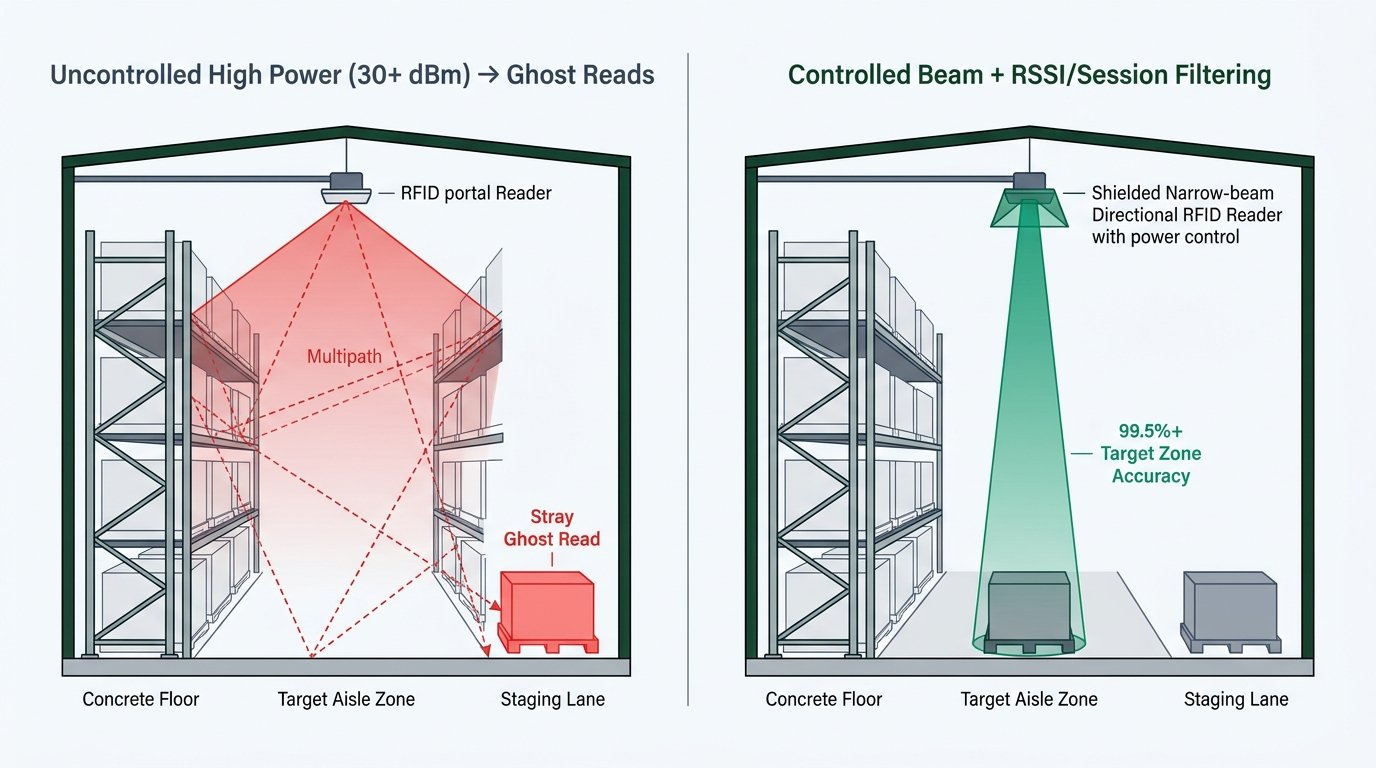
More transmit power almost always makes ghost reads worse. Turning a fixed reader up to 30–33 dBm in a metal aisle floods the space with reflected energy. Accurate zone isolation comes from controlling beam geometry, reader sessions, and software filtering—not maximum wattage.
Why Metal Racking Creates Multipath Ghost Reads
UHF RFID operates at 860–960 MHz (wavelength ~33 cm). Steel pallet uprights, wire-mesh decking, forklift masts, and reinforced concrete floors act as near-perfect RF mirrors at this wavelength. When an antenna transmits, the signal reaches tags via multiple paths: a direct line-of-sight wave plus bounced waves off opposite racks and ceilings.
These multipath waves create two operational headaches:
- Cross-aisle & staging-lane bleed (Ghost Reads): A dock-door portal or handheld sweep picks up a pallet parked 8 meters away in a staging bay or behind a steel upright because a reflected path happened to constructively interfere at that tag's location.
- False-negative nulls: Conversely, two reflected waves arriving 180° out of phase can cancel each other at a specific spot, making a stationary tag invisible until the antenna moves 10 cm.

A 4-Layer Playbook to Eliminate Ghost Reads
High-accuracy warehouse deployments (99%+ zone precision) combine physical, RF, protocol, and middleware controls rather than relying on any single setting:
| Control Layer | Specific Adjustment | Why It Stops Ghost Reads | Typical Target Setting |
|---|---|---|---|
| 1. Physical & Tag Placement | Use directional on-metal tags (hard ABS or printable flexible anti-metal) on rack faces; avoid metal-edge corners | On-metal tags radiate primarily forward away from the steel beam, reducing back-lobe pickup from adjacent aisles | Mount ≥50 mm away from upright edges; consistent facing direction |
| 2. Antenna & RF Power | Lower TX power; use narrow-beamwith (45°–60°) or linear-polarized antennas aimed downward | Confines RF energy inside the target portal or aisle; avoids illuminating ceiling trusses and opposite racks | Start at 20–24 dBm for portals; step up only until target zone hits 100% |
| 3. Gen2 Protocol Tuning | Use Session 2 or Session 3 with Target A/B persistence for static inventory; Session 0/1 for fast portals | Prevents fast-moving or stationary background tags from dominating every inventory round | See FYRFID's Session & Search Mode guide for exact reader profiles |
| 4. Middleware Filtering | Filter by Read Count + RSSI floor + Phase-angle velocity | Stray multipath reads typically have low read counts (1–2 hits), weak RSSI, and erratic phase compared to assets passing through the zone | Require ≥3–5 reads within window AND RSSI > threshold (e.g., -62 dBm) |

Handheld Cycle Counting vs. Fixed Dock-Door Portals
Different workflows require different multipath strategies:
- Handheld aisle audits: Operators walking down a metal rack aisle should set handheld power to medium (18–22 dBm) for bin-level verification, or use a Geiger-counter / RSSI proximity filter so tags from the rack behind them are excluded.
- Fixed dock-door portals: Install RF-absorbent foam or metal-backed shielding panels on the outer sides of portal frames if staging pallets sit within 3 meters of the dock door. Pair with directional phase-based motion detection (two antenna columns or dual-beam phased array) so only tags physically moving *through* the threshold trigger a ship/receive event.

Pilot Acceptance Criteria for Operations Directors
Never sign off on a warehouse RFID rollout based on a static "100% read rate" demo alone. Include a negative control test in your acceptance protocol: place 20 tagged steel totes or racks just outside the target read zone (e.g., 1.5 m behind the dock door or in the adjacent aisle) and run 20 consecutive passes. Your pass criterion should be ≥99.5% true-positive reads inside the zone AND 0% un-filtered ghost reads from the adjacent staging zone.
Why Your RFID Count Changes Every Time: Reader Power, Sessions, and Search ModesUnderstand how EPC Gen2 Sessions (S0–S3) and Search Modes affect static vs. moving tag populations.
Industrial On-Metal RFID Tags: Engineering & Sourcing GuideReturn to the Option A Topic Cluster hub for tag selection, curved-surface RF engineering, and material TCO.