Before you source
These three technologies solve three different problems and none of them substitutes for the others. A microchip proves permanent identity to a vet or shelter after a pet is already found. An NFC tag lets anyone who finds the pet contact the owner immediately, without needing an app or a vet visit. A Bluetooth tracker helps locate a pet that hasn't been found yet, but only within range of a compatible network. A serious pet-safety product line usually needs to explain all three clearly, not sell one as if it replaces the rest.
Three Different Moments, Three Different Technologies
An implanted microchip is a passive, low-frequency (134.2kHz) transponder built to the ISO 11784/11785 standard, the same identification standard covered in our cattle ear tag guide. It's inserted under the skin by a vet, has no battery, lasts the animal's lifetime, and is only readable by a dedicated microchip scanner, the kind vets and shelters carry, not a consumer phone. Its entire job is proving permanent identity once an animal is already in front of someone with the right scanner. FYRFID doesn't manufacture implantable microchips; we're covering this here because pet owners frequently confuse it with the other two technologies, and understanding what it does and doesn't do is the first step to choosing the right product for what's still missing.
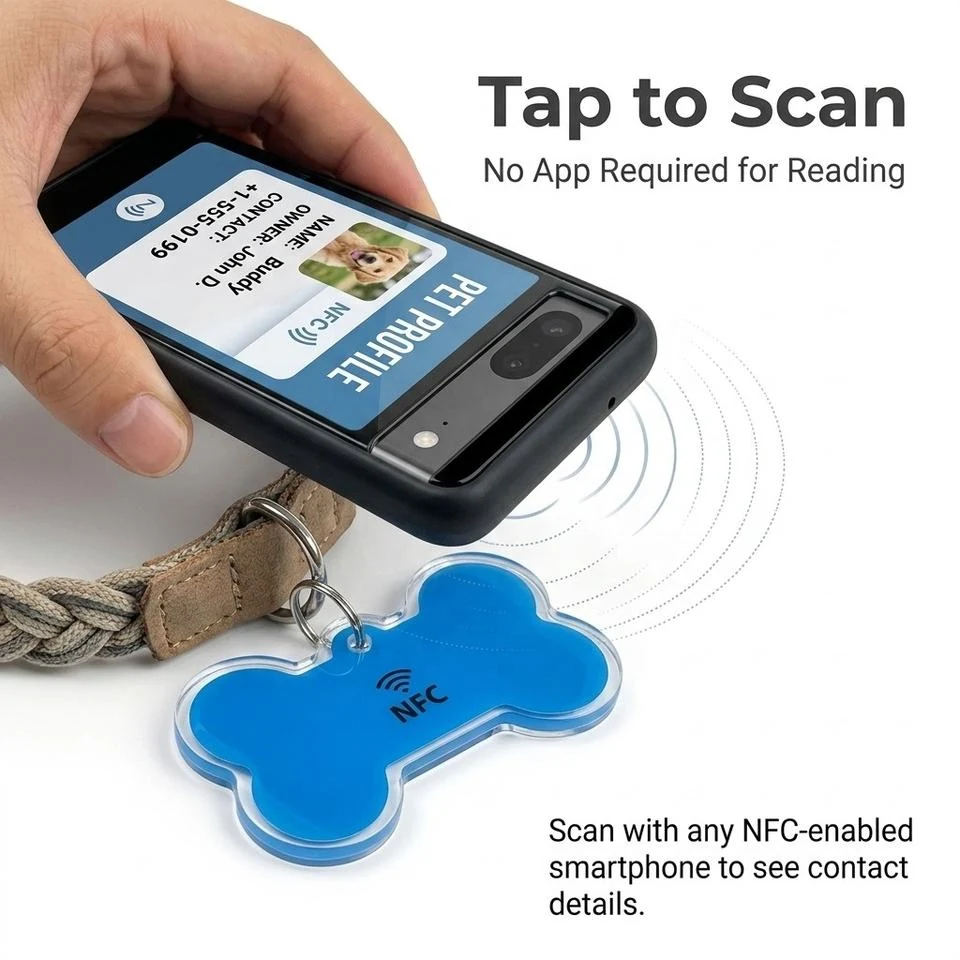
An NFC pet tag is a passive HF tag (13.56MHz) worn externally on the collar, readable by tapping almost any modern smartphone against it, no app required to read the basic contact data. This is the technology a finder actually needs at the moment they find a wandering pet on the street: no vet visit, no special scanner, no waiting. Our silicone collar tag (FYT-ANI-005) runs an NXP NTAG213 chip, reads at 0-5cm, and is built from medical-grade silicone rated IP68 and -30°C to +80°C, sized Ø25 to Ø38mm to fit different collar widths.

A Bluetooth Find My tracker is an active, battery-powered device, a genuinely different category from either passive RFID technology above. Our MFi-compatible smart tag tracker (FYT-AST-004) works with Apple's Find My network specifically, using nearby iPhones to relay an approximate location back to the owner, similar in concept to an Apple AirTag. This is the only one of the three that can help locate a pet that hasn't been found by a person yet, but it depends entirely on being within range of the compatible device network, doesn't work the same way on non-Apple ecosystems, and needs a battery that eventually runs down. Confirm the exact chipset and battery specification with FYRFID engineering for your specific sourcing requirement, since this is a fast-moving product category.
| Microchip | NFC tag | Bluetooth tracker | |
|---|---|---|---|
| What it proves | Permanent legal identity | Immediate owner contact info | Approximate real-time location |
| Who can read it | Vet or shelter with a scanner | Anyone with a smartphone, tap only | Owner, via a compatible app/network |
| Needs a battery | No | No, fully passive | Yes |
| Works if collar is lost | Yes, implanted permanently | No, tag is on the collar | No, tracker is on the collar |
| Helps before the pet is found | No | No | Yes, within network range |
| Sold by FYRFID | No, veterinary product | Yes (FYT-ANI-005 and others) | Yes (FYT-AST-004) |
Why a Product Line Usually Needs More Than One
A microchip and an NFC tag are genuinely complementary, not competing: the microchip is the permanent backup if the collar and tag are ever lost, the NFC tag is what makes a chance encounter with a stranger resolve in minutes instead of a shelter's holding period. Recommending an NFC tag as a "replacement" for microchipping is inaccurate and can leave a pet owner under-protected if the collar comes off. The honest pitch is that the NFC tag handles the fast, no-equipment-needed case, while a vet-administered microchip remains the permanent fallback.
A Bluetooth tracker adds a genuinely different capability, active search before a person ever finds the pet, but it's also the option most dependent on ecosystem and battery, worth positioning clearly as a premium add-on rather than a base-layer identification product.
What Actually Goes Wrong When These Get Conflated
- An NFC tag marketed as if it tracks location in real time, when it only works the moment someone finds the pet and taps it, disappointing a customer expecting GPS-style tracking.
- A customer assuming an NFC tag replaces microchipping entirely, leaving no permanent ID if the collar is lost or removed.
- A Bluetooth tracker sold without clarifying it depends on a specific device ecosystem's network coverage, not universal real-time GPS.
- Chip memory and read range treated as interchangeable across NFC tag constructions, when NTAG213/215/216 options carry different memory capacity worth confirming for your data or app requirements.
- No sample tested against the actual target smartphones and NFC-reading apps intended for the finished product before a bulk order.
Before You Place a Production Order
- Confirm which problem you're actually solving: immediate contact on discovery (NFC), permanent backup identity (microchip, sourced separately from a veterinary supplier), or active location search (Bluetooth tracker).
- Confirm chip memory requirements (NTAG213 at 144 bytes versus larger NTAG215/216 options) against whatever data or linked profile the finished product needs to store.
- Confirm construction and sizing against the target collar width and the animal size range you're selling for.
- If including a Bluetooth tracker in the line, confirm the specific ecosystem compatibility and battery life with FYRFID engineering rather than assuming universal tracking capability.
- Test a sample against real target smartphones and NFC reading behaviour before committing to a full production order.
The same ISO 11784/11785 standard behind pet microchips governs livestock ear tags. This covers the LF FDX-B compliance question in more depth.