Before you order
Confirm your actual wash temperature and cycle count before comparing tag constructions. A commercial laundry running 60-70°C cycles and a hospital laundry running high-temperature sterilization cycles at 135°C are not the same problem, and a tag rated for one will not necessarily survive the other. Every construction below is genuine UHF, EPC Gen2 / ISO 18000-6C, so frequency isn't the decision. Durability under your real wash profile is.
Why Laundry Tags Fail Before Anyone Notices
A laundry tag's failure mode is rarely dramatic. It doesn't stop reading on day one, it survives dozens of cycles and then starts missing reads intermittently as the antenna inside slowly degrades from repeat exposure to heat, water and mechanical tumbling. By the time a linen tracking system shows a rising rate of "tag not found" errors, the tags that are failing were probably marginal for the wash profile from the start. The fix isn't a better reader, it's the right construction for the actual wash cycle.
All the constructions below run standard UHF, EPC Global Class 1 Gen2 / ISO 18000-6C, the same air interface as a fixed portal reader or handheld scanner already covered elsewhere on this site. That means reader compatibility isn't the differentiator between them. Attachment method, wash-cycle rating and operating temperature are.
Four Real Constructions, Four Different Jobs
Sew-in or iron-on care labels (FYL-SP-007) integrate into the garment's existing label, sewn in or heat-applied at 215°C for 18 seconds. Built from high-temperature nylon washed cloth with metal fibre yarn, rated up to 200 wash cycles and short-term exposure to 135°C sterilization or 190°C ironing. This is the right choice when the garment already has a label position and the workflow wants RFID added without changing how the garment is finished.
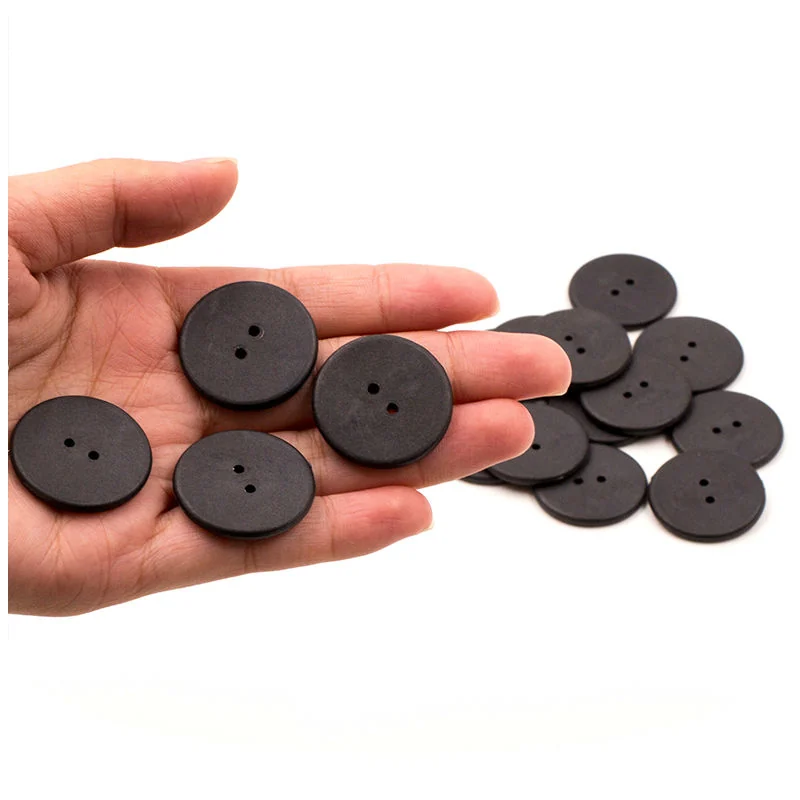
PPS coin/button tags (FYT-LAU-001) are a 20mm engineering-plastic disc that sews on like an actual button, no pouch or flat label space required. Rated for 200+ industrial wash cycles, -40°C to +120°C operating range, on an NXP UCODE 8 chip with a realistic 0.5-4m read range. Well suited to uniforms and workwear where a small, round, low-profile attachment point matters more than maximum read distance.
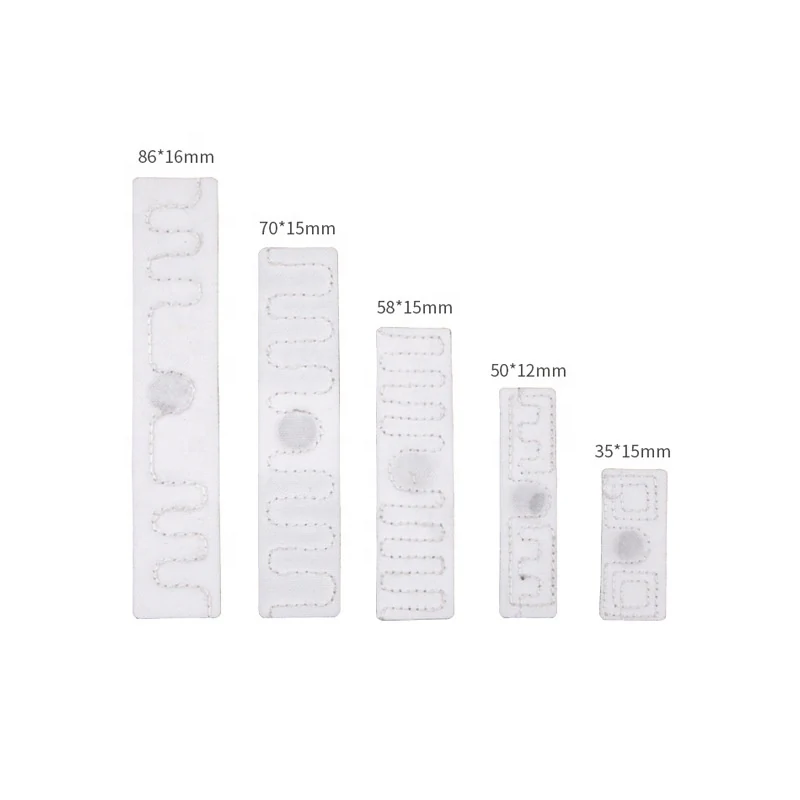
Slim flat tags (FYT-LAU-002) run thinner, a 100x12x2mm TPU strip built for hospital and hotel linen where a flat sheet or towel doesn't have a natural button position. Rated for 300+ wash cycles, -40°C to +120°C, sewn directly into a seam. This is the highest wash-cycle rating in the real catalogue among sew-in constructions, which matters for linen fleets replaced on a longer cycle than uniforms.
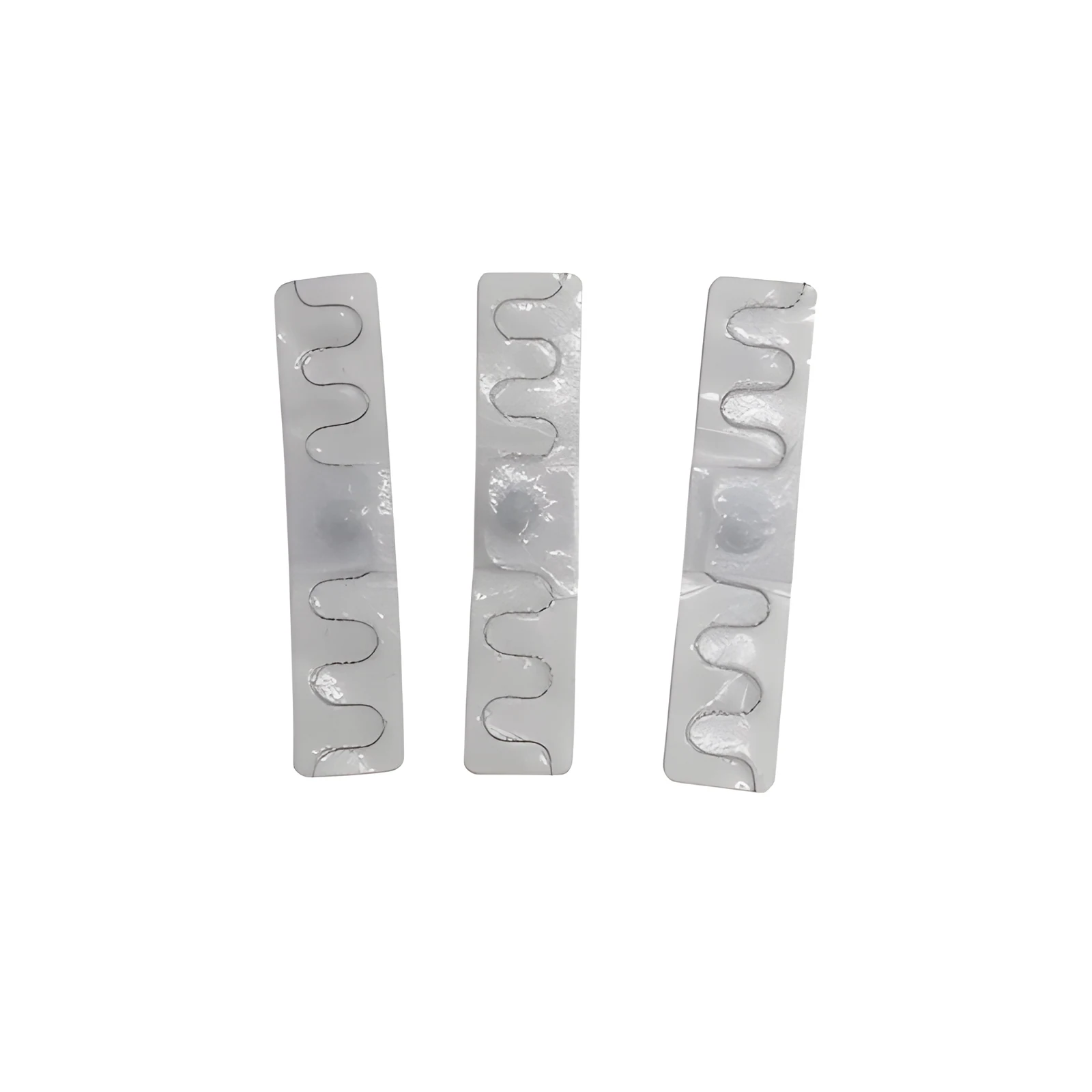
Silicone tags come in two listed versions, and their specs differ. The silicone-encapsulated polyester tag (FYT-LAU-003) is 75x25x3 mm as standard (55x12 to 75x25 mm available), on NXP UCODE 8, rated 200+ wash cycles at 95°C, -40°C to +120°C operating, with a 1-5 m read range. The soft silicone tag (55x12x2.5 mm or custom) is listed at up to 200 commercial wash cycles, IP68, an operating range of -25°C to +200°C, and a 1-7 m read distance, up to 10 m depending on the reader and antenna. Both read further than the button or slim constructions, which helps when a fixed reader counts a laundry cart rather than a handheld scanning items one at a time.
| Sew-in care label | PPS button tag | Slim flat tag | Silicone (polyester core) | Soft silicone | |
|---|---|---|---|---|---|
| SKU | FYL-SP-007 | FYT-LAU-001 | FYT-LAU-002 | FYT-LAU-003 | 55x12 mm silicone |
| Chip | Alien H3, U8, U7M or others | NXP UCODE 8 | Alien H3 | NXP UCODE 8 | H3, H4, U8, U9 or others |
| Wash cycles | Up to 200 | 200+ industrial | 300+ | 200+ at 95°C | Up to 200 commercial |
| Operating temp | -20°C to +200°C (short-term limits listed) | -40°C to +120°C | -40°C to +120°C | -40°C to +120°C | -25°C to +200°C, IP68 |
| Read range | Over 6 m fixed, 3 m handheld | 0.5-4 m | 0.5-4 m | 1-5 m | 1-7 m (up to 10 m by reader/antenna) |
| Attachment | Sew-in, pouch or heat iron | Sew-on, button style | Sew into seam | Sew-in | Sew-in or pouch |
| Best suited to | Garments with a label position | Uniforms, workwear | Flat linen: sheets, towels | Uniforms and linen at 95°C | High heat, longer read range |
| MOQ | 500 pcs | 200 pcs | 200 pcs | 200 pcs | Ask |
Attach It So It Survives the Laundry Too
A tag rated for 200 cycles still fails early if it is attached badly. Laundry-tag specialists describe three methods, each with its own rule:
- Sewing: the most durable. Do not stitch through the chip area, use reinforced stitching such as zigzag or double stitching, and place the tag along an existing seam or edge where it is less exposed to pulling and abrasion.
- Heat sealing: fastest for flat linen such as sheets and towels. Temperature, time and pressure must be set correctly, or the bond fails or the tag is damaged. For the FYRFID care label the sheet gives 215°C for 18 seconds at 0.6-0.8 MPa.
- Protective pouch: the tag sits in a sewn or heat-sealed pouch, so it can be replaced or reused when the item is retired. Useful for rotating stock in industrial laundries.
Where the Tag Is Read in a Laundry
The tag only pays for itself if it is read at the points where the laundry and its customer disagree. A typical flow has four:
| Point | What the read answers | Typical reader |
|---|---|---|
| Soiled intake | How many items did the customer send? | Fixed reader over a cart or bag, or a handheld |
| After washing and finishing | Which items reached the clean side, and which need sorting by customer? | Fixed reader at a sorting table |
| Clean dispatch | How many items went back to each customer? | Fixed reader at the dispatch point |
| Retirement | How many cycles did this item survive before it was retired? | Handheld, with the cycle count from the system |
The dispatch-versus-intake comparison is usually the read that settles disputes over missing linen, so test the tag at those two points first, in real carts, not on a bench.
What Actually Goes Wrong When the Construction Is Mismatched
- A button or slim tag ordered for a hospital laundry running 135°C sterilization cycles without confirming the tag's short-term high-heat exposure limit, not just its standard operating range.
- A sew-in care label chosen for garments with no natural label position, forcing an awkward retrofit instead of a construction built for attachment flexibility.
- Read range assumed from a spec sheet's best case (up to 10m) without confirming what the actual antenna size and mounting on the specific tag delivers.
- Wash-cycle rating treated as a hard guarantee rather than a tested figure under specific conditions; real-world results vary with detergent, water hardness and mechanical handling.
- No pilot batch tested through an actual wash-and-read cycle before committing to tagging an entire linen fleet.
Before You Place a Production Order
- Confirm your actual wash temperature, including any sterilization or high-heat drying steps, not just the standard wash cycle.
- Confirm the expected tag lifespan against the linen's own replacement cycle. A tag rated for fewer cycles than the linen's service life becomes the weak point in the system.
- Confirm the attachment method against the garment or linen type: a button tag suits a uniform, a flat sew-in tag suits a sheet or towel.
- Confirm the realistic read range for your reader setup (fixed portal vs handheld) against the specific tag size, not the catalogue's best-case number.
- Run a pilot batch through your actual wash-and-read cycle before committing to a production order for the full linen fleet.
If linen carts are read at a sorting or loading point rather than item by item, the same portal fundamentals covered here apply to a laundry read station.