Before you order
A Tyvek wristband is single-use by design, worn once, not removed and re-worn. If your event needs a wristband that survives multiple days of removal and reattachment, or repeated use across a season, a PVC or silicone band is the better fit. Tyvek's whole value proposition is being cheap, fast to produce, and destroyed the moment someone tries to pass it to another person.
What Tyvek Actually Is, and Isn't
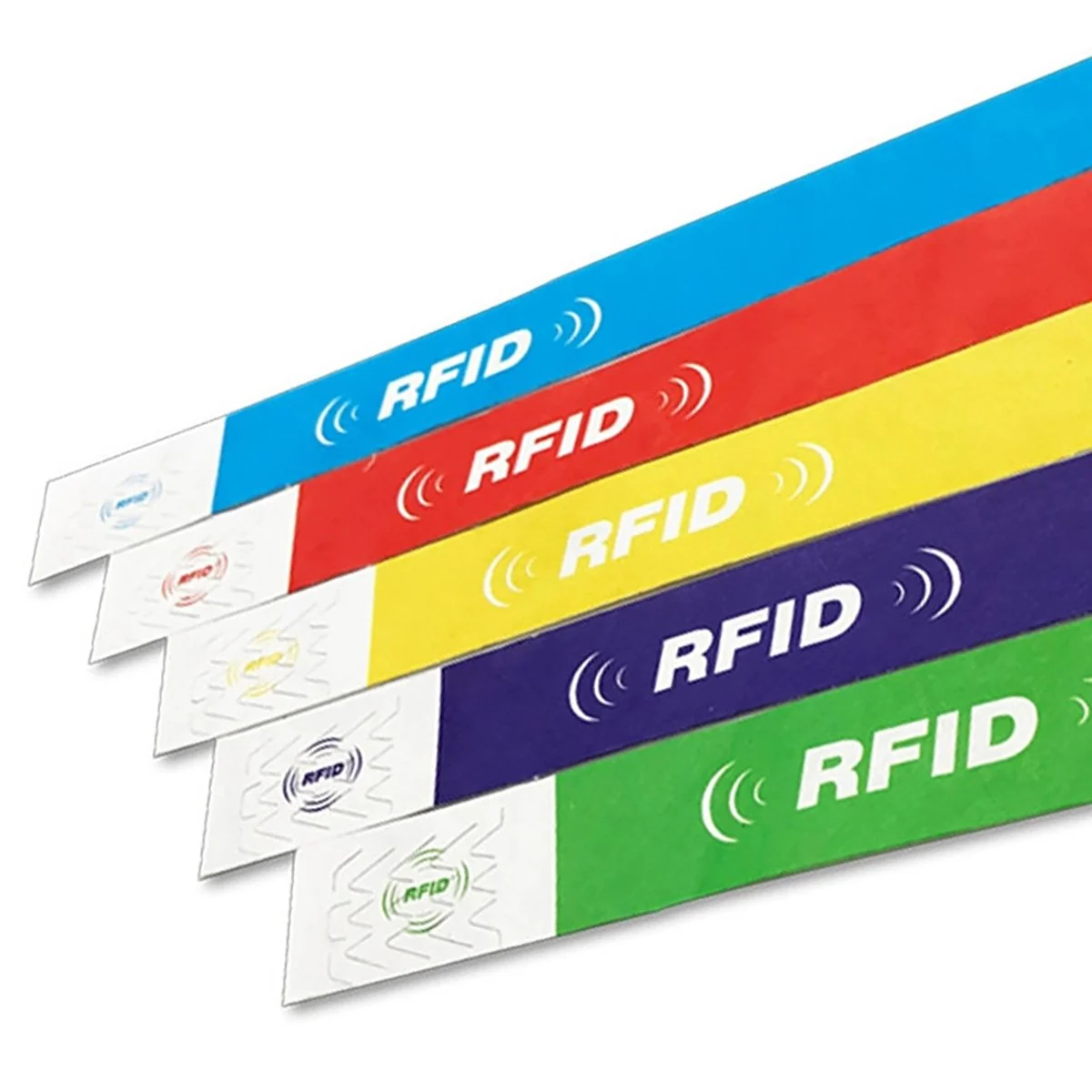
Tyvek is DuPont's spunbond polyethylene material, the same family of tough, tear-resistant paper-like sheet used in envelopes and protective packaging. As a wristband, it's printed, cut into a strip with an embedded RFID or NFC inlay, and closed with an adhesive tab. "Waterproof surface" in the spec sheet means it resists splashes and sweat, not that it's built for sustained submersion. A Tyvek band will survive a few hours poolside; it is not the right choice for a water park where guests are in and out of the pool all day, where a PVC or silicone construction holds up better over repeated wetting.
The other thing Tyvek isn't: reusable. Once the tamper-evident adhesive closure is sealed, removing it deforms the material enough that reattaching it convincingly isn't possible. That's a deliberate anti-fraud feature, not a manufacturing limitation, and it's the main reason Tyvek is the standard choice for single-night festivals, club events and day passes rather than multi-day passes that get taken on and off.
The Tamper-Evident Closure Is the Whole Point
The adhesive closure is what actually stops wristband transfer at the gate, not the RFID chip. Our FYW-TVK-001 model uses a tamper-evident adhesive strip that stretches and visibly deforms if someone tries to remove and reapply it, so a security team can spot a tampered band on sight, and a chip that's been physically removed from its original band won't read correctly once the band structure is broken. If your event has a real problem with wristband sharing or resale, confirm the closure mechanism specifically, since not every disposable wristband on the market actually deforms on removal.
Confirm the Chip Before You Print a Single Wristband
Our basic Tyvek model (FYW-TVK-001) runs NFC / HF 13.56MHz on an NXP NTAG213 or MIFARE Classic 1K chip, a 0-5cm read range, ISO/IEC 14443A air interface. Our full-color model (FYW-TVK-006) adds LF 125kHz and UHF options on request, alongside HF chips from MIFARE, NTAG and ICODE families. The chip has to match whatever reader system is already installed at the gate, and getting this wrong after printing means a wristband that looks correct and doesn't scan. If a third-party access-control or ticketing vendor is running the gate hardware, confirm the exact chip and frequency with them before finalising the order, not after the wristbands arrive.
| FYW-TVK-001 | FYW-TVK-006 | |
|---|---|---|
| Chip / frequency | NFC/HF 13.56MHz — NTAG213 or MIFARE Classic 1K | LF 125kHz, HF 13.56MHz (MIFARE/NTAG/ICODE), UHF on request |
| Read range | 0-5cm | Confirm for selected chip |
| Colors | Standard print | 8 stock colors (red, blue, green, yellow, orange, purple, pink, white) plus custom print |
| Closure | Tamper-evident adhesive, stretches if removed | Tamper-evident adhesive strip |
| Size | 250×25mm standard, 19mm/25mm width options | 250×25mm standard, custom sizes available |
| MOQ | 500 pcs (sample 20 pcs) | 1,000 pcs |
| Lead time | 5-7 days sample, 10-15 days bulk | 7-10 working days |
Color Coding: A Real Tool for Multi-Tier Access
Beyond the RFID chip itself, Tyvek's low cost makes it practical to run a different colour per day, per ticket tier, or per access zone at a single event, letting security staff make a fast visual check before a guest ever reaches a scanner. This only works if colour assignment is locked down before printing, since a colour mix-up in a bulk order of thousands of bands is far more expensive to fix after the fact than to double-check on the proof.
What Actually Goes Wrong When the Wrong Construction Gets Ordered
- Tyvek ordered for a multi-day water park pass: repeated wetting and drying weakens the paper and adhesive well before the pass period ends.
- Chip frequency ordered without confirming it against the installed gate readers, resulting in wristbands that print and look correct but don't scan on site.
- Colour-tier assignment finalised after the print run started, requiring a costly reprint rather than a proof correction.
- A closure type assumed to be tamper-evident without confirming it actually deforms on removal, undermining the entire anti-transfer purpose of choosing Tyvek in the first place.
- No test scan of a sample wristband against the actual gate reader before the full production order ships.
Before You Place a Production Order
- Confirm the chip and frequency against your actual gate reader system, not just against what's cheapest on the spec sheet.
- Confirm your event's actual exposure to water and sustained heat; a multi-day water event usually needs PVC or silicone instead of Tyvek.
- If running multi-day or multi-tier access, lock in colour assignment and confirm it on the proof before the production run starts.
- Confirm the closure type is genuinely tamper-evident if wristband sharing or resale is a real risk at your event.
- Test an encoded sample against your actual reader and entry workflow before committing to the full production quantity.
If check-in or gate scanning runs off a handheld rather than a fixed reader, confirm the read range and chip compatibility here before ordering wristbands.
Sources & standards
- ISO/IEC 14443-2:2020 — ISO/IEC, reference