Quick answer
NFC is a specific, standardised subset of HF RFID (13.56 MHz) built for short-range communication with ordinary smartphones. RFID is the broader umbrella covering LF (125 kHz), HF (13.56 MHz) and UHF (860-960 MHz). If a consumer needs to tap the tag with their own phone, you need NFC specifically. If you need multi-metre range or bulk reading of many tags at once, you need UHF, and no phone can read it.

NFC Is a Subset of RFID, Not a Rival to It
RFID (Radio-Frequency Identification) is the umbrella term for any technology that uses radio waves to identify a tagged object: it spans multiple frequency bands, from 125 kHz low frequency through 13.56 MHz high frequency to 860-960 MHz ultra-high frequency (UHF), each with different range and use cases.
NFC (Near-Field Communication) is a specific, standardised implementation defined by the NFC Forum that operates at 13.56 MHz (the same frequency as HF RFID) with a short, deliberately limited read range of a few centimetres and, critically, built-in support for being read by ordinary smartphones without a dedicated reader. Every NFC tag is technically an HF RFID tag; not every HF RFID tag is built to the NFC Forum standard that makes it phone-readable.
In practice, a common mismatch is this: someone asks for "an RFID sticker" when the project actually needs one of two very different things (a phone-tappable NFC tag, or a several-metre UHF label), and the two are built on physically different antennas: a small coiled loop for NFC/HF, a long dipole for UHF. Send us the read distance and whether a consumer's own phone needs to tap it, and the frequency picks itself.
The Practical Difference: Range and Reader Requirements
| LF (125 kHz) | HF / NFC (13.56 MHz) | UHF (860-960 MHz) | |
|---|---|---|---|
| Typical read range | A few cm | A few cm to ~10 cm | 1-8 m |
| Reads with a smartphone? | No | Yes (NFC Forum tags) | No (needs a dedicated reader) |
| Bulk / multi-tag reading | Not practical | Not practical, one tap at a time | Yes, many tags at once |
| Governing standard | No single formal standard | ISO/IEC 14443, ISO/IEC 15693, NFC Forum | ISO/IEC 18000-6C (EPC Gen2) |
| Typical use case | Legacy access control, animal ID | Access cards, NFC business cards, product taps | Warehouse, retail inventory, asset tracking |
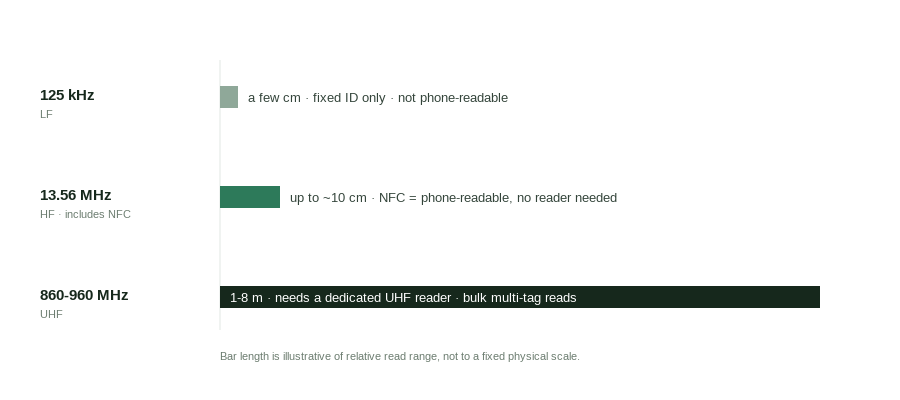
The distinction that actually matters for choosing a product is read range and what can read the tag. NFC/HF tags read at a few centimetres and can be read by a smartphone: ideal for a consumer tapping a product, a business card or a poster, or short-range secure identification like a door badge.
UHF RFID tags read at anywhere from one to several metres (up to around eight metres for some ear-tag and asset-tracking constructions) but need a dedicated UHF reader: no smartphone can read a UHF tag. UHF is the right choice for warehouse pallet reading, retail inventory counts, or any scenario where you need to read many tags at a distance, in bulk, without physically tapping each one, and most UHF deployments encode tags to the GS1 EPC numbering scheme so identities stay consistent across a supply chain.
NFC Forum Tag Types
Within NFC specifically, the NFC Forum defines several tag types with different memory and chip characteristics. Type 2 is by far the most common in commercial products: this is the category NXP's NTAG213, NTAG215 and NTAG216 belong to, distinguished mainly by user memory (144, 504 and 888 bytes respectively). Type 4 tags, which include chips like NTAG 424 DNA, add AES encryption and dynamic authentication, used where anti-counterfeiting or secure identity matters more than raw cost.
A Real Project: The Same Product, Two Different Tags at Two Different Stages
A brand launching an authentication programme for a physical product often needs both technologies at once, on different tags, at different stages of the same product's journey, not a single either/or choice. Working backward from the actual workflow makes this concrete.
- At the warehouse and in transit, a UHF label on the shipping carton lets a fixed reader or handheld count and verify hundreds of units in a single pass, the same bulk-reading workflow covered in our source-tagging guide. No consumer ever touches this tag.
- At the point of sale or in the customer's hands, an NFC tag on the individual product lets the end buyer tap it with their own phone to verify authenticity or see product information, no app, no dedicated reader, just the phone already in their pocket.
- These are genuinely two different tags solving two different problems in the same programme. A single antenna can't be tuned to both a multi-metre UHF read and a few-centimetre NFC tap; the physical construction is different, which is why dual-frequency labels (a UHF inlay and an NFC inlay combined on one label) exist specifically for projects that need both roles without applying two separate stickers.
The practical takeaway: don't ask "RFID or NFC" as if it's one decision. Ask which stage of the product's life each read is happening at, who or what is doing the reading, and whether that's a person with their own phone or a fixed system counting in bulk. The frequency falls out of those answers rather than being chosen first.
A Simple Way to Decide
- Does a consumer or staff member need to read this with their own phone, with no extra hardware? If yes, you need NFC specifically, not just any HF chip.
- Do you need to read a tag from more than a few centimetres away, or read many tags at once without individually tapping them? If yes, you need UHF, and a phone will not work at all.
- Is this a secure badge or credential that only needs to work with your own access reader, never a personal phone? A non-NFC HF chip such as MIFARE is often the more cost-effective and more securable choice, since MIFARE DESFire and similar chips support encryption that basic NFC Forum tags (NTAG213/215/216) do not.
Common Misconceptions
"NFC and Bluetooth are the same thing." They are not. Bluetooth is a longer-range wireless pairing protocol used for continuous data exchange (headphones, speakers, fitness trackers); NFC is a near-field, tap-to-connect protocol most often used for a single quick data exchange or identification. Some products use both (NFC to initiate a Bluetooth pairing, for instance), but they solve different problems.
"RFID tags can always be tracked from far away." Only UHF tags read at metres of range, and even then only within an active reader's field. A UHF tag sitting on a shelf with no reader nearby is not broadcasting its location to anyone. LF and HF/NFC tags read at centimetres, making them unsuitable for any kind of remote tracking scenario people sometimes worry about.
125 kHz vs 13.56 MHz Proximity Cards: Which Access System Do You Have?If you are evaluating an access-card system specifically, this guide covers the two most common proximity card frequencies in more depth.